OFFERING · AI & ML PLATFORMS

Unified AI/ML Platform

Every AI workload. One platform. Yours.
A self-service platform for any AI or ML use case: large language models, classical machine learning, computer vision, custom frameworks. Every team serves itself (LLMs as Models as a Service, notebooks, training, publishing) while the platform holds the governance, monitoring, and internal billing in place underneath. It runs on whatever hardware you have and makes the most of it. Open source at every layer, owned by you, rebuildable from your Git in minutes.
The platform extends the Local AI & Sovereign Inference setup: same gateway, same governance, with training, custom workloads, and full self-service on top.
Talk to an engineer
How it lands

Converging into one platform

Self-service for every use case, with governance, monitoring, and internal billing across shared GPU resources.

One platform Multiple teams, shared compute
  1. 01
    LLM inference Teams, applications, and agents consume the governed model catalog.
  2. 02
    Workspaces Notebooks with GPU profiles, ready to run.
  3. 03
    Model publishing Publish to the catalog; consumers switch models by changing a name.
  4. 04
    Training Templated training jobs; promotion from experiment to catalog is a reviewed change.
One platform Governed gateway and model catalog, identity and policy, workload isolation and fair scheduling. Supports LLMs, classical ML, computer vision, and custom frameworks.
Governance · monitoring · internal billing across all of it: per team, per model, per workload.
Shared GPU resources Workload isolation and fair scheduling underneath, so teams share the hardware without booking it between themselves.
Inference, workspaces, model publishing, and training share one platform. Governance, monitoring, and internal billing run across every layer, and the workloads share the GPU resources underneath.
Who it's for

More teams than GPUs.

Your AI ambitions outgrew a single project.

Data scientists want notebooks, ML engineers want training runs, product teams want endpoints, and everyone wants the same accelerators. Without a platform, that's a rota and a queue; small jobs occupy whole GPUs while inference starves.

And nobody can answer who uses what.

AI adoption without a platform means shadow tools, unmanaged keys, and no answer to the questions every CIO eventually asks: who is using which model, on what data, at what cost, and under whose approval.

And you refuse to rent the foundation.

No vendor telemetry, no cloud control plane, no external licensing checks, no per-GPU meter attached to your growth.
What we build

Self-service for every use case.
Governed, measured, billed.

Self-service for every use case.

OpenAI-compatible endpoints and a key for consumers. Notebooks with GPU profiles, ready to run, for data scientists. Templated training jobs for ML engineers. One-click model publishing for the teams shipping products. No tickets, no infrastructure knowledge required, and no ceiling: advanced users go as deep as they need. LLM, classical ML, computer vision, or a framework we've never heard of: if it needs accelerated compute, it's a tenant.

Models as a Service, for LLMs.

The platform's LLM layer is delivered as MaaS: a curated internal catalog of served open-weight models behind the governed gateway, consumed by teams, applications, and agents as OpenAI-compatible endpoints. New models are evaluated against your workloads, optimized for your hardware, published to the catalog, and versioned; consumers switch models by changing a name, not by touching infrastructure. Budgets, throughput allocations, guardrails, and audit apply per team, exactly as the governance layer below defines them.

Governance built in.

Per-team identity, model and data access policies, guardrails on every endpoint, and a full audit trail of who ran what, on which model, with which data. Approval flows where the organization requires them, enforced by the platform rather than written down in a policy document.

Monitoring across the whole estate.

Usage, performance, latency, and cost, per team, per model, per workload. The platform's own health on the same substrate. When something is slow or expensive, you see where and why, not just that.

Internal billing.

Usage metering turns into showback or chargeback: every team's consumption measured, budgeted, and billed internally at your rates. Quotas and rate limits keep any one team from eating the cluster, and finance finally gets a number per project instead of one opaque GPU bill.

Real multitenancy.

Workload isolation and fair scheduling underneath all of the above, so teams share the hardware without booking it between themselves.

Yours, rebuildable.

Every line of configuration lives in your Git; nothing is applied by hand. The entire platform, clusters included, is a declaratively managed object that can be redeployed in its current state in minutes. Change management comes out of the box: every change is a reviewable commit.
The stack

Every layer open.
Every layer yours.

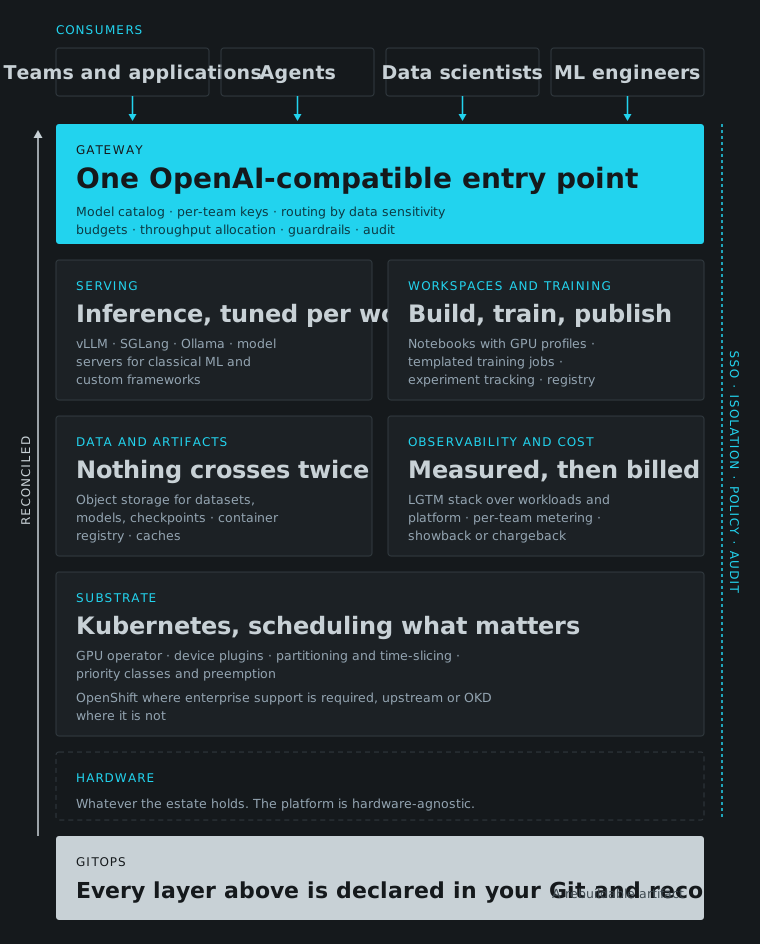
Unified AI/ML Platform: the stack
Layered architecture: hardware underpins the platform, GitOps reconciles every layer, and identity and policy span the stack. Configuration lives in your Git.

Substrate.

Kubernetes, with the GPU operator, device plugins, partitioning and time-slicing, priority classes and preemption, so scheduling reflects what actually matters. OpenShift where enterprise support is required, upstream or OKD where it isn't.

Serving.

vLLM and SGLang for throughput-critical inference, Ollama for small local footprints, model servers for classical ML and custom frameworks. Per-endpoint autoscaling, and a serving recipe tuned per workload: quantization, tensor and pipeline parallelism, continuous batching, prefix caching, KV cache optimization. Tuning routinely halves the hardware a given workload needs.

Gateway.

One OpenAI-compatible entry point holding the model catalog, per-team keys, routing by data sensitivity, budgets, throughput allocation, guardrails, and audit. Consumers change a model name, never infrastructure.

Workspaces and training.

Notebooks with GPU profiles, templated distributed training jobs, experiment tracking, and a model registry where promotion from experiment to catalog is a reviewed change.

Data and artifacts.

Object storage for datasets, models, and checkpoints. A container registry for images. Caches so nothing crosses the perimeter twice.

Observability and cost.

The LGTM stack over both the workloads and the platform itself, plus per-team, per-model consumption metering feeding showback or chargeback.

Identity and policy.

SSO against your directory, per-team isolation and quotas, policy-as-code admission control, and a full audit trail.

GitOps.

Everything above declared in your Git and reconciled continuously. The platform is a rebuildable artifact, not a configured installation.
The open-source argument

Your engineers can extend it.
With AI assistance.

The projects in this stack are extensively documented in public, which means they are in the training data of every capable model. Your engineers can troubleshoot, tune, and extend the platform with AI assistance, because the models genuinely know these systems. Proprietary internals aren't in any model's training data, so every non-trivial question routes back to the vendor and its certified representatives, recreating exactly the dependency the platform was built to remove.

How we deliver

Projects

Built with you.
Owned by you.

Platform design and build, from GPU architecture through the self-service layer, with combined teams.
All code and configuration are your property, in your Git, from day one.
Operations & Support

Day-2, run by us or run with you.

Standard day-2 operation of the platform under SLA: monitoring, capacity, upgrades, model lifecycle, incident response. Because the whole platform is code, development and support continue in the same repository and the same SDLC: your engineers and ours raise pull requests against the same modules, review each other's changes, and ship through the same pipeline.
We can carry the operation entirely or share it with your team, and the split can change whenever you want it to.
The platform is the enabler: your models, your data, your hardware, your Git. Bring the workloads and the teams, and we design it with you.
Talk to an engineer

Own your AI.
Not a subscription to it.